

Forming part of an extensive programme of GIMA Knowledge Exchange Workshops will be the latest one-day session entitled ‘Finance for Non-Finance Managers’. Perfect for those without a finance background, this lively and interactive topic will help delegates become more comfortable with financial reporting and data. With places filling up fast, interested parties are urged to book their place… Read more
Beyond Plants: What Garden Sport Could Mean for 2026 Buying Plans
Monday, June 15, 2026 - 13:59
Garden centre buyers heading into 2026 are working in a market that looks meaningfully different to the one many of us came up in. Catering has surpassed live plants in monthly share for the first time in years. Outdoor furniture posted a 42% year-on-year jump in July 2025. Non-gardening departments continue to outperform plants on a like-for-like basis. The HTA's market data through 2025 tells a consistent story: the customer is spending in the parts of the store that sit slightly outside the plant aisle, and those parts are increasingly carrying the trading quarter.
That shift opens up a fair question for anyone building a 2026 range. If the customer is in the store for a reason that has very little to do with plants, what else should they be able to walk out with? Outdoor cooking and heating have been the obvious answers for the past decade, and the Easter trading window continues to prove that food and outdoor living drive footfall and basket size when the weather behaves. The category we want to look at sits just past those, earning quiet attention from buyers tracking the right trends: garden sport.
What we mean by garden sport, and what we don't
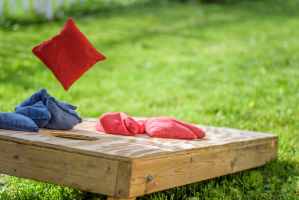
Garden sport, for the purposes of a 2026 buying plan, means the off-the-shelf, supplier-delivered end of home practice and outdoor play: lawn games, football goal posts, badminton and net games, croquet and bowls sets, and home practice equipment across sports including golf, cricket and tennis. It does not mean installation services, court construction, or anything requiring a builder on site. The buyer-test is the same one that applies to outdoor cooking: does it ship from the supplier, sit on a pallet, and walk out with the customer or onto a delivery van? If yes, the category fits the model. If it means bespoke design and a week of groundwork, it belongs somewhere else.
That distinction matters because the shopper is much closer to the existing garden centre customer than to the dedicated sports retailer. They are buying for the garden as a leisure space, not for performance. The customer picking up a pizza oven on a Saturday is in scope for a family croquet set or a garden practice net. The conversion logic is closer to outdoor furniture than to specialist sporting goods, and that framing is what helps these ranges earn their shelf space.
Why the category is earning attention now
The simplest answer is participation, and the shape of it. Sport England's latest Active Lives survey shows record adult participation through 2025, with the growth concentrated in flexible, individual and family-led activity rather than in organised team sport. People are choosing the formats they can fit around the rest of their week, which is exactly the audience that practises and plays at home, between any formal sessions a specialist retailer might capture. Golf is one of the clearer commercial expressions of this: England Golf reported record club membership of 750,071 and a 34% jump in junior participation last year. Tennis, badminton and casual lawn-game activity sit alongside it as part of the same broader shift toward home and garden-led play.
The second answer is what those participants buy. A home practice or family-play setup is mostly soft goods and accessories: nets, mats, balls, target equipment, garden goals, replacement parts. These are repeat-purchase, low-friction items that suit a season-led, footfall-driven environment. They are also weather-tolerant and multi-season, helping fill the autumn and winter gap left by softer plant categories.
What separates a genuinely retailable range
Three things make a garden sport range work for a garden centre rather than a sports retailer. The first is the delivery model: supplier-direct, no installation, pallet-friendly. The second is shopper crossover: products the existing customer would consider an extension of their garden, not a step into specialist territory. The third is margin sustainability through accessories and consumables, where bird care and outdoor cooking have built their long-term positions, and where garden sport has the same structural strength.
Family lawn games illustrate the model at its simplest: croquet sets, garden bowls, oversized skill games, often ranged seasonally already by a handful of garden centres and traditionally fronted by UK suppliers like Big Game Hunters and Garden Games. Football and net-game lines (goal posts, badminton sets, garden cricket sets) sit a step up in price but follow the same delivery profile: boxed, pallet-friendly, no installation. Home practice golf is the more interesting test case. It is the sport with the strongest documented participation surge, but historically the one most likely to require a club, a coach, or a bespoke installation, none of which fit a garden centre's retail model. The question is whether the off-the-shelf end has caught up. That is where garden-suitable golf practice nets earn their place: standalone units alongside hitting mats and chipping targets, all shipping ready to use straight from the box. UK specialists like Golf Swing Systems have built out this end of the category specifically for that retail model.
The 2025 GIMA Awards Outdoor Leisure shortlist gives a useful read on where suppliers are pointing. Outdoor kitchens, fire pits and lifestyle pieces dominated the category, but the judging criteria, durability, design, consumer appeal, repeat-purchase potential, apply just as cleanly to garden sport. The suppliers winning recognition in adjacent ranges are building consumable-friendly, weather-tolerant product lines that retail well in non-specialist environments. That is the model garden sport ranges will need to match to earn permanent shelf space.
Where to pay attention before next season
Spoga+gafa in Cologne has historically been the European shop window for outdoor living, and outdoor leisure has steadily edged into more of its hall plans. For UK buyers, Glee Birmingham in September remains the most efficient way to see the supplier base in one place. The run-up to Glee is the right window to ask suppliers about garden sport extensions to existing leisure ranges, pallet-friendly stocking units, and POS that helps a customer self-serve through a category they may not have shopped before.
The category will not be the biggest piece of any 2026 plan. But for buyers watching catering, outdoor furniture and lifestyle ranges quietly take over the trading quarter, garden sport sits in the same direction of travel. It is off-the-shelf, it has consumable margin, the shopper is already in the building, and the participation data underneath it is going the right way. That is usually enough reason to look closely. The buyers who range it well in 2026 will be the ones doing the obvious thing six months before everyone else.
By Dakota Murphey
- Log in to post comments